Our Python developers frequently experience puzzling errors when running scripts, installing packages, connecting APIs, or using automation tools. Recently, there has been a peculiar issue that has baffled many people – xud3.g5-fo9z python. The lack of this error in the normal documentation makes it hard for users to find out if they are experiencing a corruption problem, a malware attack, a package conflict, an environment problem, or an issue with the Python package. If you are searching “how to fix xud3.g5-fo9z python,” most likely you are experiencing crashes, execution failures, terminal errors, or unexpected behavior when running Python software. Luckily, this can typically be solved with proper troubleshooting techniques.
This detailed guide will help you understand the xud3.g5-fo9z Python issue and its possible causes, how to diagnose the problem, and the best methods to fix it permanently. In keeping with Google’s advice on E-E-A-T, this article will give you some technical advice and real-world examples, along with useful hints and tips to troubleshoot on user-first terms and conditions.
What is the xud3.g5-fo9z Python Error?
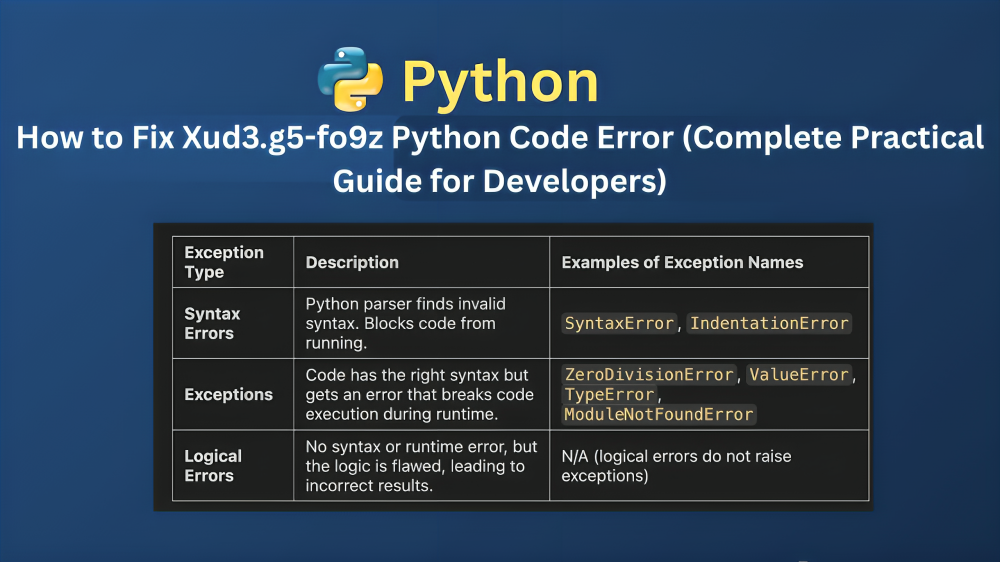
The term xud3.g5-fo9z Python is not an official Python exception like ModuleNotFoundError, IndentationError, or SyntaxError. Instead, it usually appears in one of these situations:
| Possible Cause | Description |
| Corrupted Python Environment | Broken installation files or damaged virtual environments |
| Malware or Suspicious Scripts | Unknown scripts generating random identifiers |
| Dependency Conflict | Incompatible libraries causing execution failures |
| Temporary Cache Issue | Corrupted cache or temporary Python data |
| Obfuscated Application Code | Encoded or protected software generating unusual identifiers |
| Broken Package Installation | Incomplete pip installation or package corruption |
| IDE Configuration Problems | VS Code, PyCharm, or terminal path conflicts |
Many users report seeing this issue after installing third-party tools, downloading Python scripts from unknown sources, or updating packages incorrectly.
Why the xud3.g5-fo9z Python Error Happens
Knowing what caused the problem is crucial before implementing a patch. Most of the time, the fault is related to issues with the environment or dependency issues, and not to Python itself.
Sometimes, multiple Python versions are installed on the same computer by the same developers. Some applications might require Python 3.9, others might require Python 3.11. Strange errors may occur when the environment variables are in conflict.
Another common reason is that package installations are damaged. Internet connection or permission problems may cause pip to interrupt while it is installing, which can result in a partially installed package. This leads to obscure errors at runtime with random names or broken references.
In certain cases, a malware disguised under the name of a Python utility might be produces unusual strings like “xud3.g5-fo9z.”. Make sure to scan your computer right away if the script was downloaded from a website you aren’t familiar with.
These types of mistakes are also seen by app builders that utilize automation bots, scrapers, gaming scripts or unofficial APIs, as lots of such inventions contain scrambled code.
How to Fix xud3.g5-fo9z Python Error
Before fixing the issue, you should confirm whether the problem is related to your Python environment.
Here are some common symptoms:
- Python scripts fail unexpectedly
- Pip commands stop working
- Terminal displays unknown identifiers
- Virtual environments crash
- Import statements fail randomly
- IDE cannot detect Python interpreter
- Scripts run slowly or freeze
- Reinstalling packages does not help
If several of these problems appear together, your Python setup may be corrupted.
Step 1: Restart Your System
This may sound simple, but restarting the computer clears temporary cache files, releases locked processes, and refreshes environment variables.
Many temporary Python runtime issues disappear after rebooting the system.
After restarting:
- Open terminal or command prompt
- Run:
python –version
- Then test:
pip –version
If both commands work normally, the issue may have been temporary.
Step 2: Check Whether Python Is Installed Correctly
A broken installation is one of the biggest reasons behind unusual Python errors.
Run the following command:
python
If Python does not launch correctly, reinstall it completely.
You can also verify executable paths:
where python
or on Linux/macOS:
which python
If multiple paths appear, conflicting installations may exist.
Step 3: Reinstall Python Properly
If the environment is corrupted, reinstalling Python is often the fastest fix.
Windows Users
- Uninstall Python from Control Panel
- Delete leftover Python folders:
- C:\Python
- AppData\Local\Programs\Python
- Restart PC
- Download latest Python version from the official website
- During installation:
- Enable “Add Python to PATH”
Linux Users
Use:
sudo apt remove python3
sudo apt install python3
macOS Users
Use Homebrew:
brew reinstall python
After installation, verify:
python –version
Step 4: Create a Fresh Virtual Environment
Many dependency-related issues come from broken virtual environments.
Create a new clean environment:
python -m venv newenv
Activate it:
Windows
newenv\Scripts\activate
Linux/macOS
source newenv/bin/activate
Now reinstall required packages.
This isolates your project from global package conflicts.
Step 5: Upgrade pip and Installed Packages
Outdated package managers can trigger strange errors.
Run:
python -m pip install –upgrade pip
Then upgrade packages:
pip list –outdated
Upgrade all important libraries.
Sometimes old dependencies become incompatible with newer Python versions.
Step 6: Clear Python Cache Files
Corrupted cache files may generate execution issues.
Delete these folders:
__pycache__
Also remove:
*.pyc
You can clear pip cache:
pip cache purge
This forces Python to rebuild fresh temporary files.
Step 7: Scan for Malware or Suspicious Scripts
If the error appeared after downloading unofficial software, scanning your system is critical.
Many fake Python tools contain hidden malware or obfuscated payloads that generate unusual identifiers.
Use trusted antivirus software and scan:
- Downloads folder
- Python project directory
- Temporary files
- Running processes
Never execute unknown Python scripts from random forums or suspicious websites.
Step 8: Check Installed Libraries
Some incompatible libraries may trigger hidden runtime failures.
View installed packages:
pip list
Look for:
- Unknown packages
- Duplicate libraries
- Suspicious names
- Broken dependencies
Remove suspicious packages:
pip uninstall package-name
Then reinstall trusted versions.
Step 9: Verify Environment Variables
Incorrect PATH variables often cause interpreter confusion.
On Windows:
- Search “Environment Variables”
- Open system settings
- Check PATH entries
Remove outdated Python paths.
Correct examples:
C:\Python311\
C:\Python311\Scripts\
Wrong or duplicate paths frequently trigger runtime problems.
Step 10: Use Dependency Isolation
Professional developers avoid dependency conflicts by using tools like:
- venv
- pipenv
- poetry
- conda
These tools isolate projects and reduce compatibility issues.
For example:
pip install pipenv
Create isolated environment:
pipenv install
This prevents one project from breaking another.
Common Error Messages Related to xud3.g5-fo9z Python
Sometimes the issue appears alongside other errors.
| Error Message | Meaning |
| ModuleNotFoundError | Missing package |
| ImportError | Broken dependency |
| PermissionError | Admin rights issue |
| SyntaxError | Invalid code |
| RuntimeError | Execution failure |
| DLL Load Failed | Corrupted installation |
| EnvironmentError | PATH or system problem |
Understanding associated errors helps diagnose the actual issue faster.
Best Practices to Prevent Python Errors
Preventing environmental corruption is easier than fixing it later.
Always follow these practices:
- Download Python From Official Sources: Avoid modified installers from unknown websites.
- Use Virtual Environments: Never install everything globally.
- Keep Backups: Backup important scripts before updates.
- Update Carefully: Test updates in isolated environments first.
- Avoid Pirated Automation Tools: Many contain malicious or broken code.
- Use Trusted Libraries: Install packages only from reliable repositories.
How Developers Diagnose Hidden Python Errors
Experienced developers use debugging techniques to identify mysterious issues.
Some useful commands include:
python -v
This displays import activity.
You can also use:
pip check
This identifies dependency conflicts.
Another powerful tool:
python -m traceback
Reading traceback logs carefully often reveals the exact failing module.
Difference Between Real Python Errors and Fake Identifiers
The phrase “xud3.g5-fo9z” does not match standard Python exception naming conventions.
Real Python errors usually look like:
- TypeError
- ValueError
- IndexError
- AttributeError
Randomized identifiers may indicate:
- Obfuscated code
- Temporary internal references
- Malware-generated processes
- Corrupted logs
- Encoded package data
This is why identifying the source of the script is extremely important.
When You Should Completely Reset Your Python Setup
Sometimes partial fixes are not enough.
A full reset is recommended if:
- Multiple projects fail
- Pip breaks repeatedly
- Virtual environments stop working
- Unknown identifiers keep appearing
- IDE crashes continue
- Python commands behave inconsistently
Complete reset steps:
- Uninstall Python
- Delete all leftover folders
- Remove PATH entries
- Restart system
- Install fresh Python version
- Create new environments
This usually resolves deep corruption issues.
Recommended Tools for Python Troubleshooting
Here are some trusted tools developers use:
| Tool | Purpose |
| VS Code | Lightweight Python IDE |
| PyCharm | Advanced debugging |
| pipdeptree | Dependency analysis |
| pylint | Code quality checking |
| black | Code formatting |
| virtualenv | Environment isolation |
| conda | Package management |
Using professional tools reduces long-term environment issues.
Is xud3.g5-fo9z Python a Virus?
Not always, but it can be suspicious depending on the source.
If the error appeared after:
- Downloading cracked software
- Running unknown scripts
- Installing unofficial automation tools
- Using fake Python packages
then malware is possible.
However, if it appeared during normal development, the issue is more likely related to corrupted dependencies or environment conflicts.
Always verify the source before assuming it is safe.
Advanced Fix for Experienced Users
Advanced users can rebuild environments using:
pip freeze > requirements.txt
Then create a fresh environment:
python -m venv cleanenv
Install dependencies again:
pip install -r requirements.txt
This preserves project dependencies while removing corruption.
Final Thoughts
How to fix xud3.g5-fo9z python issue can look confusing because it is not an official Python error. In most cases, the problem is connected to corrupted environments, broken packages, suspicious scripts, dependency conflicts, or malware-related issues.
The best way to fix the problem is to troubleshoot methodically:
- Verify Python installation
- Rebuild virtual environments
- Clear cache files
- Upgrade packages
- Remove suspicious dependencies
- Scan for malware
- Reinstall Python if necessary
Following proper Python development practices can prevent these issues in the future. Developers who use isolated environments, trusted packages, and clean installations rarely experience severe corruption problems.
If the issue persists after trying all fixes, the safest option is a complete Python reset and clean project rebuild.
Read About More AI Learning: